
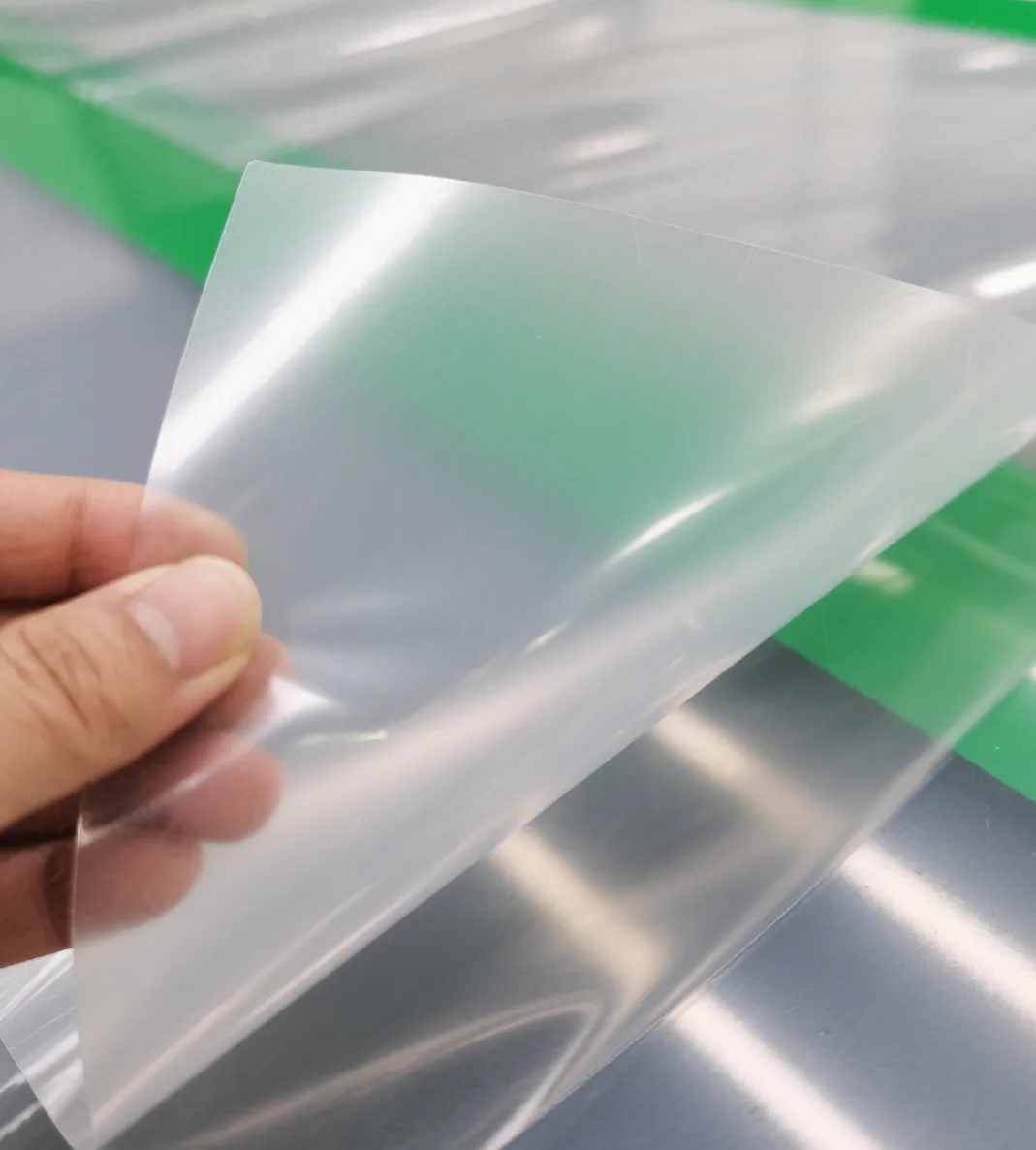
PFAS Free TPU Film and What Coming PFAS Rules Mean for Buyers
Substance Scope, Declarations and the Questions to Ask a Supplier
PFAS free TPU film is not a marketing position, it is a documentation question. TPU chemistry does not require per- and polyfluoroalkyl substances, but a finished film can still carry them through processing aids, release agents or packaging.
That distinction matters, because the declaration a buyer signs is usually about the article rather than about the polymer.
This article explains what PFAS means in a film context, where these substances can enter an otherwise fluorine-free product, and how to build a claim that survives an audit.
What PFAS Covers in a Film Product
PFAS is a broad family defined by the presence of carbon-fluorine bonds, and it includes thousands of substances used for water, oil and stain repellency. The definition is deliberately wide, which is why a simple "PFAS free" claim is harder to support than it looks.
In a plastic film, PFAS is rarely the polymer itself. It appears as a processing aid, a mould release agent, a surface coating or an additive that improves slip or repels oil.
The packaging around the roll can also contain PFAS, particularly in grease-resistant paper or coated liners. If the claim covers the delivered article, the packaging is inside the boundary.
That is why a resin-level statement is not enough. The declaration has to describe the article as delivered, including anything that touches it before it reaches the customer.
Is TPU Itself a PFAS Material?
No. TPU is built from polyols, diisocyanates and chain extenders, and none of those contain carbon-fluorine bonds. A standard TPU formulation is therefore outside the PFAS definition at the polymer level.
That statement is about chemistry, not about the finished product. It does not cover what a converter adds, and it does not cover contamination from equipment that previously ran fluoropolymer material.
Cross contamination is a real audit finding. A line that has run PVDF or a fluoropolymer masterbatch can carry residues into the next product, and the residue is invisible in the finished film.
This is why a credible supplier talks about line allocation and cleaning validation as well as about the recipe. The chemistry answer is easy; the process answer is the one that requires evidence.
Where PFAS Enters an Otherwise Clean Product
The usual entry points are processing aids, release agents and coatings. Each is added in small quantities and each can defeat a claim that was true at the resin stage.
- Fluoropolymer processing aids used to reduce melt fracture in extrusion
- Release agents applied to rollers, belts or moulds where the film is formed
- Oil and water repellent coatings applied for stain resistance
- Grease-resistant paper, moulded fibre trays or coated liners in the packaging
- Recycled content streams that carry legacy fluorinated material from other products
The recycled content point is the least obvious and the most difficult. A recycled feedstock can contain legacy substances that were legal when the original product was made, and a PFAS-free claim on a recycled grade requires testing rather than assumption.
What Buyers Are Being Asked to Declare
Brands increasingly ask suppliers for a substance declaration rather than a certificate. The declaration names the article, the scope of the assessment and the basis of the conclusion, and it is signed by someone accountable for it.
Regulatory pressure is moving in that direction. Authorities in Europe have been developing a broad restriction proposal covering PFAS as a group, and several other jurisdictions have introduced reporting or prohibition measures for specific uses.
The practical effect for a film buyer is that the question is no longer limited to food contact. It now appears in textile procurement, automotive supply agreements and consumer goods specifications, often as a questionnaire attached to the purchase order.
Because the rules differ by jurisdiction and are still evolving, a supplier should state which scope a declaration covers rather than claiming universal compliance. A declaration that names the regulation and the date is more useful than one that says "compliant" without qualification.
Comparing What Each Document Actually Proves
| Document | What it covers | What it does not cover |
|---|---|---|
| Resin statement | The base polymer composition | Additives, processing aids, packaging |
| Full material declaration | All intentionally added substances | Impurities and cross contamination |
| Targeted test report | The substances in the test panel, on the sample tested | Substances outside the panel, other batches |
| Non-use declaration | A commitment about what is deliberately added | Anything present but not added on purpose |
| Process statement | Line allocation and cleaning controls | Formulation details |
A strong file usually combines three of these. A non-use declaration alone answers the question a lawyer asked and leaves the technical question open.
Building a Claim That Holds Up
Start from the article and work backwards. Define what the claim covers, list every input that touches the film, and confirm each one against the PFAS definition before writing anything on a data sheet.
- Define the claim boundary as the article delivered, including packaging and liner
- Collect non-use declarations for every raw material, not only the base resin
- Confirm line allocation and cleaning records for equipment that also runs fluorinated material
- Test the finished article where the claim has to survive an audit or a customer questionnaire
- State the regulation and the assessment date on the declaration so it can be rechecked
Keep the scope narrow enough to defend. "PFAS free" written alone invites a question the supplier may not be able to answer, while "no PFAS intentionally added, assessed against the current definition at the date shown" is a statement that can be verified.
Questions That Produce a Useful Answer
Ask which substances were assessed rather than whether the product is compliant. A supplier who can name the list has done the work, and a supplier who cannot is repeating a marketing line.
Ask whether the film runs on a dedicated line or shares equipment with fluoropolymer material. The answer determines whether a formulation-level statement is enough or whether cleaning validation is also needed.
Ask about the packaging separately. A grease-resistant liner or a coated carton can carry the substances a buyer is trying to avoid, and packaging is often outside the scope of a resin declaration.
Ask what happens when the formulation changes. A declaration is only valid for the material it describes, so a change in supplier or additive package should trigger a new document rather than an updated date on the old one.
What This Means for Film Specification
For most TPU film applications, the PFAS question is answered by the chemistry and confirmed by documentation. There is no need to reformulate, and no performance penalty for a fluorine-free product in ordinary film work.
The exception is where the product relies on oil or stain repellency. Replacing a fluorinated treatment usually means accepting a different performance level or choosing a different mechanism, and that trade should be tested rather than assumed.
The available film grades are listed on the TPU film product range, and a declaration should be requested alongside the technical data sheet rather than after the order.
Zhejiang Huanlong New Material Science Technology Co.,Ltd produces film on 44 lines across three manufacturing bases, with two R&D centres and more than 30 engineers. Huanlong holds ISO 9001:2015, ISO 14001 and ISO 45001 certification, and documentation requests are handled through the technical team rather than through sales alone.
The short version: TPU chemistry contains no PFAS, but the finished article can pick it up from processing aids, release agents, coatings or packaging. Ask for a scoped declaration with a date, plus evidence of line allocation.
A PFAS claim is only as good as the boundary it defines.
Frequently Asked Questions About PFAS Free TPU Film
Does TPU contain PFAS?
Standard TPU chemistry does not contain carbon-fluorine bonds, so the polymer is outside the PFAS definition. Additives, processing aids, coatings and packaging are separate inputs and have to be checked individually.
Do I need a test report or a declaration?
Both have a role. A declaration covers the formulation and the process, while a test report covers what is actually present in a sample. A declaration without process evidence can miss cross contamination, and a test without a declaration cannot describe intent.
Can recycled TPU be declared PFAS free?
Only with evidence. Recycled feedstock can carry legacy substances from products made under older rules, so a recycled grade needs testing rather than a declaration based on the original polymer.
Is a fluorine-free film weaker?
No. PFAS is not a structural component of TPU, so removing it does not reduce mechanical performance. The only place it matters is where a fluorinated coating was providing oil or stain repellency.
What scope should a declaration state?
The article as delivered, the substances assessed, the regulation or definition used and the date of assessment. A declaration without those four elements is difficult to rely on in an audit.
Send the scope your customer requires and the end use, and the relevant documentation can be prepared for PFAS free TPU film. Huanlong can confirm the substance position for its film ranges and the process controls behind it.
See How the Film Is Made Ask About PFAS Free TPU Film